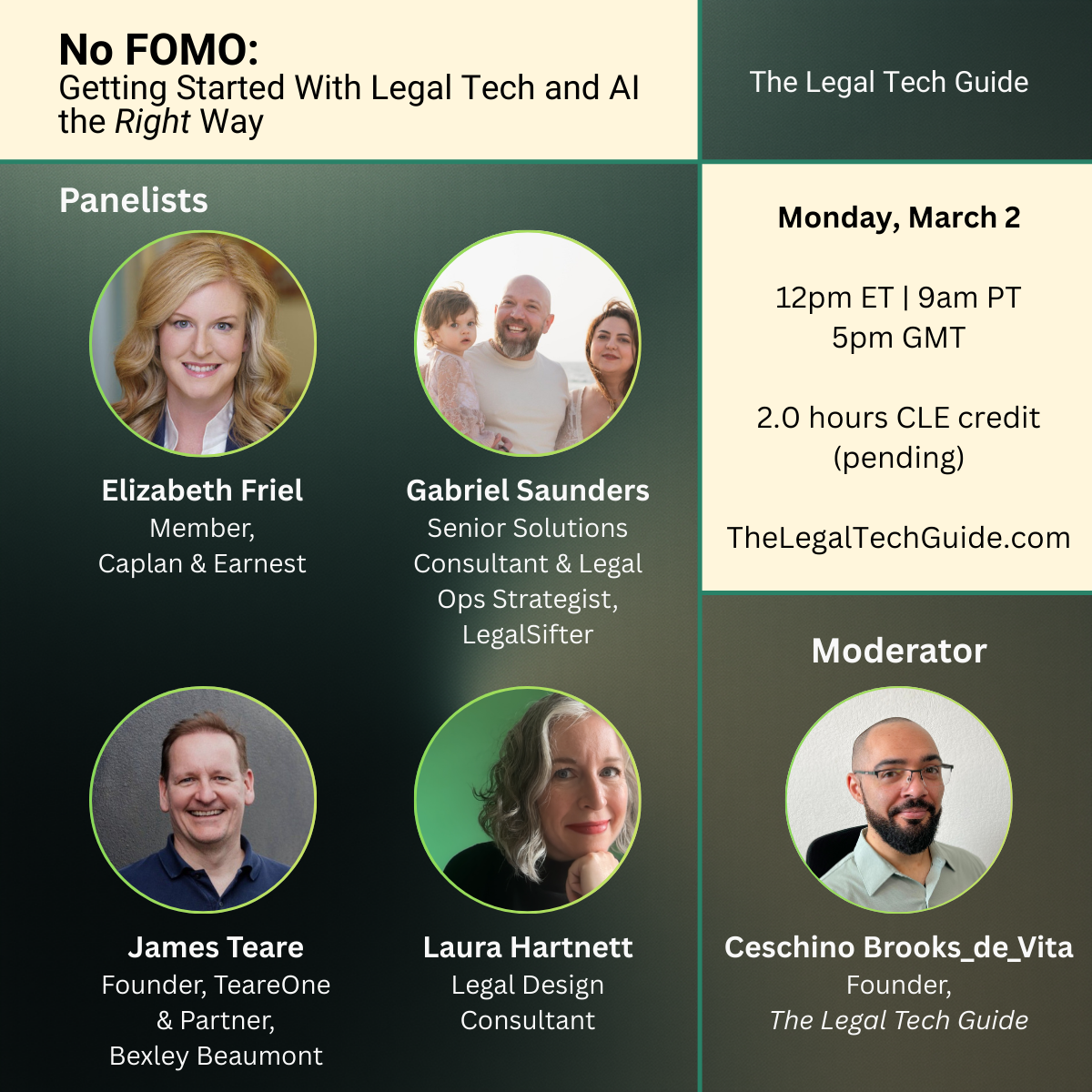
Webinar - No FOMO: Getting Started With Legal Tech and AI the Right Way
Legal teams are under pressure to “do something” about AI and automation, but many are making technology decisions without clear goals, defined processes, or realistic implementation plans. The cost of premature adoption is not just financial; it affects trust, morale, and professional credibility.
This webinar provides a disciplined framework for deciding when to move forward, when to pause, and how to avoid costly, reputation-damaging technology missteps.
Details
Live webinar
Format: Moderated panel discussion with structured framework presentation and live audience Q&A
Monday, March 2, 2026
12pm ET | 9am PT | 5pm GMT
Duration: Approx. 2 hours
2.0 CLE credit hours (accreditation pending in California and Texas)
Who This Is For
Law firm leaders
In-house counsel
Legal operations professionals
Solo and small firm practitioners
Legal teams evaluating AI and/or automation
What This Is
A practical, repeatable framework for making disciplined legal tech and AI adoption decisions inside real legal teams
Not a product demo
Not a prompt engineering course
Not a general discussion of trends
Learning Objectives
By the end of this course, participants will be able to:
Identify and navigate the cognitive and organizational factors that drive reactive legal tech adoption, including hype cycles, peer pressure, and perceived competitive risk.
Distinguish between genuine operational needs and technology-driven “solutions in search of a problem.”
Evaluate when adopting legal tech and/or AI is appropriate, and when it is not, based on professional judgment rather than market pressure.
Apply an intentional decision-making framework to legal tech and AI adoption that prioritizes client/stakeholder service, risk management, and professional responsibility.
Recognize common warning signs that indicate a technology initiative may be premature, misaligned, or unnecessary.
Panel
Elizabeth Friel
Elizabeth Friel is a member at Caplan & Earnest in Boulder, Colorado, where she advises school districts and Boards of Cooperative Educational Services (BOCES) on special education, public governance, labor relations, student privacy, and regulatory compliance. In addition to her legal practice, Elizabeth has led internal technology initiatives within her firm, focusing on thoughtful implementation and long-term sustainability. She brings a practitioner’s perspective on how technology decisions affect trust, workload, and professional credibility inside real legal organizations.
Gabriel Saunders
Gabriel Saunders is a Senior Solutions Consultant and Legal Operations Strategist at LegalSifter, where he works with legal teams to design and implement technology systems that function effectively within complex organizations. A co-founder of e-discovery firms including Casekey and GLS Litigation Services, Gabriel has built and scaled legal technology businesses and later transitioned into enterprise legal operations roles. His experience as both builder and operator informs his pragmatic approach to AI and automation, balancing innovation with workflow realities and organizational readiness.
James Teare
James Teare is the founder of TeareOne, a consultancy and technology marketplace advising law firms on the responsible identification, procurement, and governance of legal technology and AI. He is also a partner at Bexley Beaumont, a UK-based law firm known for its hybrid legal and consultancy model. James began his career working on technology-related legal matters including data infrastructure, software licensing, and digital risk. He brings a governance-focused lens to technology adoption, emphasizing professional responsibility, regulatory alignment, and long-term sustainability.
Laura Hartnett
Laura Hartnett is a legal design and management consultant with nearly 20 years of experience spanning management consulting, litigation at national and international law firms, and in-house practice at a Fortune 100 company. She works with legal teams to improve the structure and delivery of legal services using design thinking principles, with a focus on sustainable change and operational clarity. Laura brings cross-environment insight into how legal organizations can manage process, culture, and adoption without sacrificing rigor or collaboration.
Moderator: Ceschino Brooks_de_Vita
Ceschino Brooks de Vita is the creator of The Legal Tech Guide and works at the intersection of law, business, and technology. He began his career practicing corporate law at a Vault 20 firm in New York, advising investment fund sponsors and investors on complex transactions. He later transitioned into the legal technology industry, building and leading product and content marketing functions across companies focused on legal AI, contract lifecycle management, eDiscovery, and document automation. Through this blend of legal practice, MBA training, and hands-on legal tech experience, Ceschino helps legal professionals evaluate technology with transparency, discipline, and strategic perspective.
CLE & Refund Policy
2.0 CLE credit hours (accreditation pending in California and Texas).
If accreditation is not approved in the applicable jurisdiction, registrants may request a partial refund reflecting the CLE premium. Access to course materials will still be provided.
Refunds are available if requested at least 24 hours before the live event. No refunds will be issued after the event begins. All registrants will receive access to the on-demand recording.
Legal teams are under pressure to “do something” about AI and automation, but many are making technology decisions without clear goals, defined processes, or realistic implementation plans. The cost of premature adoption is not just financial; it affects trust, morale, and professional credibility.
This webinar provides a disciplined framework for deciding when to move forward, when to pause, and how to avoid costly, reputation-damaging technology missteps.
Details
Live webinar
Format: Moderated panel discussion with structured framework presentation and live audience Q&A
Monday, March 2, 2026
12pm ET | 9am PT | 5pm GMT
Duration: Approx. 2 hours
2.0 CLE credit hours (accreditation pending in California and Texas)
Who This Is For
Law firm leaders
In-house counsel
Legal operations professionals
Solo and small firm practitioners
Legal teams evaluating AI and/or automation
What This Is
A practical, repeatable framework for making disciplined legal tech and AI adoption decisions inside real legal teams
Not a product demo
Not a prompt engineering course
Not a general discussion of trends
Learning Objectives
By the end of this course, participants will be able to:
Identify and navigate the cognitive and organizational factors that drive reactive legal tech adoption, including hype cycles, peer pressure, and perceived competitive risk.
Distinguish between genuine operational needs and technology-driven “solutions in search of a problem.”
Evaluate when adopting legal tech and/or AI is appropriate, and when it is not, based on professional judgment rather than market pressure.
Apply an intentional decision-making framework to legal tech and AI adoption that prioritizes client/stakeholder service, risk management, and professional responsibility.
Recognize common warning signs that indicate a technology initiative may be premature, misaligned, or unnecessary.
Panel
Elizabeth Friel
Elizabeth Friel is a member at Caplan & Earnest in Boulder, Colorado, where she advises school districts and Boards of Cooperative Educational Services (BOCES) on special education, public governance, labor relations, student privacy, and regulatory compliance. In addition to her legal practice, Elizabeth has led internal technology initiatives within her firm, focusing on thoughtful implementation and long-term sustainability. She brings a practitioner’s perspective on how technology decisions affect trust, workload, and professional credibility inside real legal organizations.
Gabriel Saunders
Gabriel Saunders is a Senior Solutions Consultant and Legal Operations Strategist at LegalSifter, where he works with legal teams to design and implement technology systems that function effectively within complex organizations. A co-founder of e-discovery firms including Casekey and GLS Litigation Services, Gabriel has built and scaled legal technology businesses and later transitioned into enterprise legal operations roles. His experience as both builder and operator informs his pragmatic approach to AI and automation, balancing innovation with workflow realities and organizational readiness.
James Teare
James Teare is the founder of TeareOne, a consultancy and technology marketplace advising law firms on the responsible identification, procurement, and governance of legal technology and AI. He is also a partner at Bexley Beaumont, a UK-based law firm known for its hybrid legal and consultancy model. James began his career working on technology-related legal matters including data infrastructure, software licensing, and digital risk. He brings a governance-focused lens to technology adoption, emphasizing professional responsibility, regulatory alignment, and long-term sustainability.
Laura Hartnett
Laura Hartnett is a legal design and management consultant with nearly 20 years of experience spanning management consulting, litigation at national and international law firms, and in-house practice at a Fortune 100 company. She works with legal teams to improve the structure and delivery of legal services using design thinking principles, with a focus on sustainable change and operational clarity. Laura brings cross-environment insight into how legal organizations can manage process, culture, and adoption without sacrificing rigor or collaboration.
Moderator: Ceschino Brooks_de_Vita
Ceschino Brooks de Vita is the creator of The Legal Tech Guide and works at the intersection of law, business, and technology. He began his career practicing corporate law at a Vault 20 firm in New York, advising investment fund sponsors and investors on complex transactions. He later transitioned into the legal technology industry, building and leading product and content marketing functions across companies focused on legal AI, contract lifecycle management, eDiscovery, and document automation. Through this blend of legal practice, MBA training, and hands-on legal tech experience, Ceschino helps legal professionals evaluate technology with transparency, discipline, and strategic perspective.
CLE & Refund Policy
2.0 CLE credit hours (accreditation pending in California and Texas).
If accreditation is not approved in the applicable jurisdiction, registrants may request a partial refund reflecting the CLE premium. Access to course materials will still be provided.
Refunds are available if requested at least 24 hours before the live event. No refunds will be issued after the event begins. All registrants will receive access to the on-demand recording.